
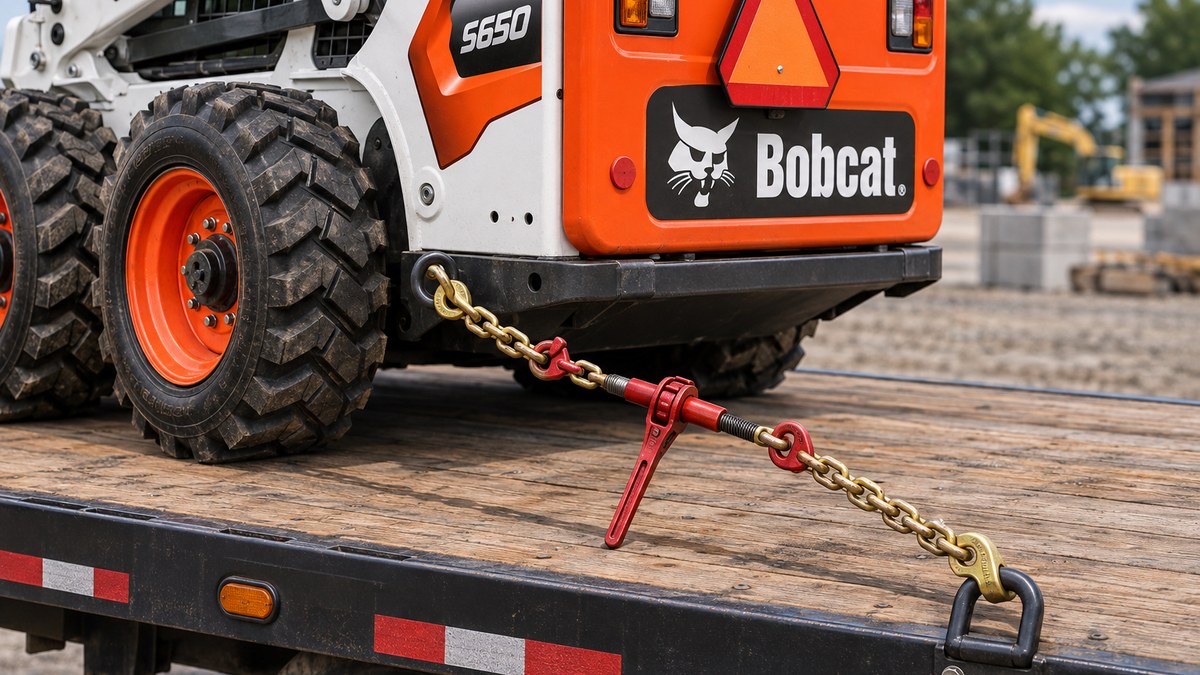
A skid steer or compact tractor can look locked down from the driver’s seat and still shift on the first hard stop. The good news? A solid tie-down routine isn’t complicated. It just has to be done the same way every time.
- Chain only to designated machine tie-down points and rated trailer anchors, never to wheels or tracks.
- Rate each tie-down by its weakest component, then check aggregate working load limits against FMCSA benchmarks.
- Secure attachments, then stop early in the trip to recheck and retension.
Start With the Trailer and the Parking Spot
Subtract your trailer’s empty weight from its GVWR. The remainder must cover the machine, attachments, securement gear and anything else riding along.
For a compact tractor, use a deck long enough for the whole machine.
Machine position controls hitch weight. Place it to meet the tongue or pin weight guidance from your tow vehicle, hitch and trailer manufacturers, then verify on a scale and stay within every axle, hitch and vehicle rating. Once a position checks out, paint a deck mark so every driver lands there.
Pick the Right Anchor Points and Hardware
Wheels and tracks aren’t tie-down points. Use only the points identified in your operator manual and rated trailer anchors. If a chain crosses a track frame, use softeners.
Both the chain and the binder should carry a stamped grade and working load limit, but a chain stamp alone doesn’t tell you what a tie-down can hold. Check the chain, the binder, each connector and both anchor points, and treat the lowest working load limit among them as the limit for that tie-down. Use that figure when adding up the aggregate working load limit.
Straps suit buckets, forks and light attachments, not the machine’s main restraint. Sleeve edges so straps can’t wear through.
For commercial haulers, FMCSA rules set the standard. Under 49 CFR 393.106, aggregate working load limit must equal at least half the cargo’s weight, and each tie-down running directly from trailer to machine counts for half its rated limit. 49 CFR 393.130 requires at least four tie-downs for wheeled or tracked equipment weighing 10,000 pounds or more, and permits alternative rules for lighter equipment.
Private haulers may not be bound by them, but they make a sound benchmark. Check your state’s rules too. If the math feels tight, add capacity.
Follow the Same Tie-Down Sequence Every Time
Build your checklist from the transport sections of your manuals. A typical routine:
- Stop in your marked position.
- Lower the attachment fully to the deck.
- Shut off the engine.
- Set the parking brake and engage any locks the manual calls for.
- Chain to designated tie-down points and rated anchors.
- Tension each binder, following any routing the manuals specify.
- Lock each binder per its instructions, then secure loose chain ends.
Never use a pipe or improvised handle extension on a binder. A tensioned binder stores energy and its handle can recoil hard, so stay out of its path.
Compact tractors are top heavy and often carry a loader or implement, so don’t get sloppy.
Lock Down the Small Stuff
Treat attachments as separate loads, following each manufacturer’s transport instructions. Secure implements and loose parts against shifting, and route restraints away from sharp edges and pinch points.
Cap flat face couplers and sleeve any hose that rubs the quick attach frame. Close the cab door and stow loose pins in the truck.
Walk It One More Time Before You Roll
Before pulling out, walk one slow lap around the trailer. Look for undamaged chains, visibly locked binders and tie-downs pulling evenly. Check the hitch and trailer brakes.
Tie-downs loosen as the load settles, so pull over somewhere safe early in the trip to inspect and retension, then keep rechecking periodically. On covered commercial hauls, 49 CFR 392.9 calls for an inspection within the first 50 miles, then whenever the driver’s duty status changes, after three hours of driving or after 150 miles, whichever comes first. The federal exemption covers occasional, unpaid hauling of personal property outside a commercial enterprise. Check state requirements separately.
Good tie-downs come from a boring, repeatable routine. Do that and your machine shows up exactly where you left it.
This post may contain affiliate links. Meaning a commission is given should you decide to make a purchase through these links, at no cost to you. All products shown are researched and tested to give an accurate review for you.