


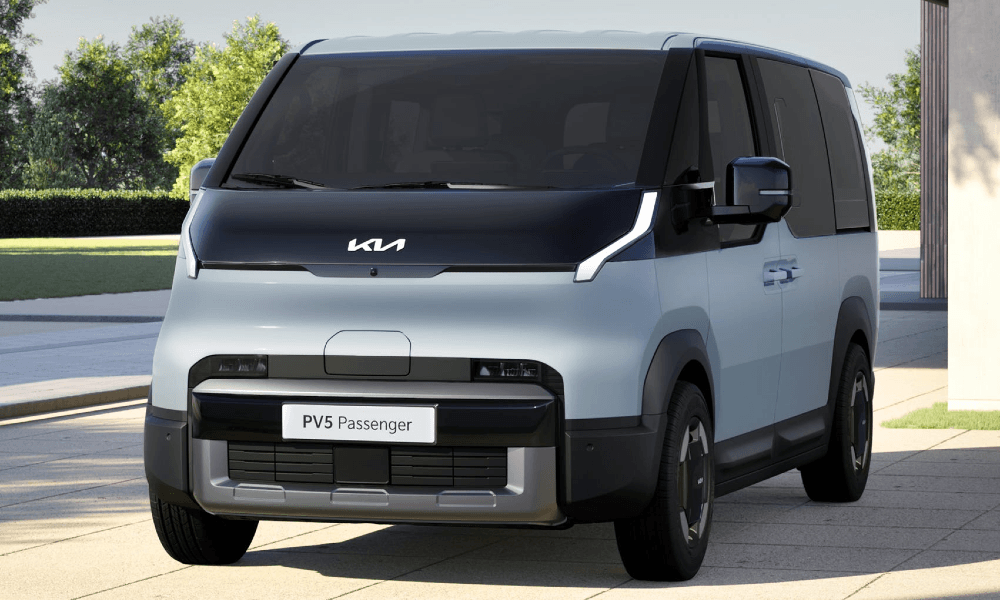
A jury of 98 automotive journalists from 33 countries has spoken, and the Kia PV5 is a top-three finalist for the 2026 World Car Design of the Year. This all-electric van, built from scratch on a purpose-designed platform, is now rubbing shoulders with the Mazda 6e/EZ-6 and the Volvo ES90 in one of the most respected design competitions on the planet. For a vehicle that doubles as a cargo hauler, people mover, and even a potential camper van, that’s quite the recognition.
- The PV5 was shortlisted as a top-three contender in the 2026 World Car Design of the Year category at the World Car Awards.
- Kia won the 2025 World Car of the Year title with the EV3, and took a double win in 2024 with the EV9.
- All six World Car Awards category winners will be announced live at the New York International Auto Show on April 1, 2026.
What Makes the PV5’s Design Stand Out?
The PV5 isn’t your typical van. It’s Kia’s first dedicated Platform Beyond Vehicle (PBV), and rather than adapting an existing platform, Kia engineered the PV5 from the ground up to support passenger, cargo, and conversion configurations from a standardized core architecture. That Lego-like building approach is what caught the jurors’ attention.
The design features proportions tuned for space and usability, including a 2,995 mm wheelbase and a compact 5.5 m turning radius for easy urban operation. Entry points are kept low, too. Step heights sit at 399 mm for the sliding door and 419 mm for the Cargo tailgate, making frequent access easy and comfortable.
Up front, the PV5 wears Kia’s futuristic Tiger Face with a clean upper section and a sturdy lower portion. Signature Star Map lighting flows into the A-pillar for a sleek, extended profile, with easy-to-swap bumper corners designed for durability and easy service. It’s a look that splits opinions on the street, but in a good way. The PV5 stands apart from any electric van on the road today.
A Lineup of Kia Electric Vehicles Built for Every Job
The PV5 is built to serve as passenger transport, cargo hauler, and wheelchair-accessible vehicle, coming in “Passenger,” “Cargo,” and “WAV” (Wheelchair Accessible Vehicle) versions. Cargo variants are where that modular design really shines. The Cargo Long offers up to 4.4 m³ of usable volume, while the High Roof version pushes that to 5.1 m³.
The modular construction means the PV5 will spawn many variants, and buyers can also have it as a bare chassis cab and drop whatever they want onto the back. Think refrigerated units, food trucks, or camper van conversions. Up to 17 different variants are planned.
Under the floor, Kia has engineered the PV5 to accommodate three batteries: 51.5 kWh and 71.2 kWh nickel manganese cobalt packs for all versions, plus a 43.3 kWh lithium iron phosphate optional battery exclusive to the Cargo. The motor puts out 120 kW of power and 250 Nm of torque. Kia quotes a max range of 249 miles on the WLTP cycle for the Passenger model with the bigger battery, and juicing from 10% to 80% takes about half an hour.
Among the growing family of Kia electric vehicles, the PV5 fills a spot that no other model in the lineup covers. It bridges the gap between personal transport and commercial utility in a way that traditional vans simply haven’t.
Kia’s Growing Streak at the World Car Awards
This shortlisting didn’t come out of thin air. Kia has been building a run of success at the World Car Awards that’s hard to ignore. In 2025, the EV3 claimed World Car of the Year honors, and the previous year, the EV9 swept both World Car of the Year and World Electric Vehicle categories. Earlier wins include the EV6 GT as 2023 World Performance Car, and the Telluride and Soul EV sharing 2020 World Car of the Year and World Urban Car titles.
The PV5 has also been racking up trophies elsewhere. Selected unanimously by 26 commercial vehicle journalists, the PV5 earned the 2026 International Van of the Year title, becoming the first Korean van and Asia’s first EV to receive this honor. The PV5 Cargo received the maximum five-star rating in Euro NCAP’s 2025 commercial Van Safety assessment. And in a jaw-dropping real-world test, the PV5 Cargo Long achieved a Guinness World Records title for the greatest distance (693.38 km) travelled by a light-duty battery-powered electric van with maximum payload on a single charge.
Can the PV5 Win It All in New York?
The PV5 faces stiff competition. The other finalists in the World Car Design of the Year category are the Mazda 6e/EZ-6 and the Volvo ES90. Both are stylish sedans with plenty of design credibility. A commercial van beating two sleek passenger cars in a design contest would be a statement moment for the industry.
The jurors will trim down the contenders to one winner, announced during the 2026 New York International Auto Show on April 1, marking the 21st anniversary of the World Car Awards partnership with the show.
Whether or not the PV5 takes the top prize, the fact that a purpose-built electric van earned a spot alongside premium sedans says something about where automotive design is heading. Practicality and beauty don’t have to be at odds with each other, and the PV5 is proof of that. For Kia, a design win would add another trophy for a model the company is positioning as the foundation of its commercial EV strategy.
