


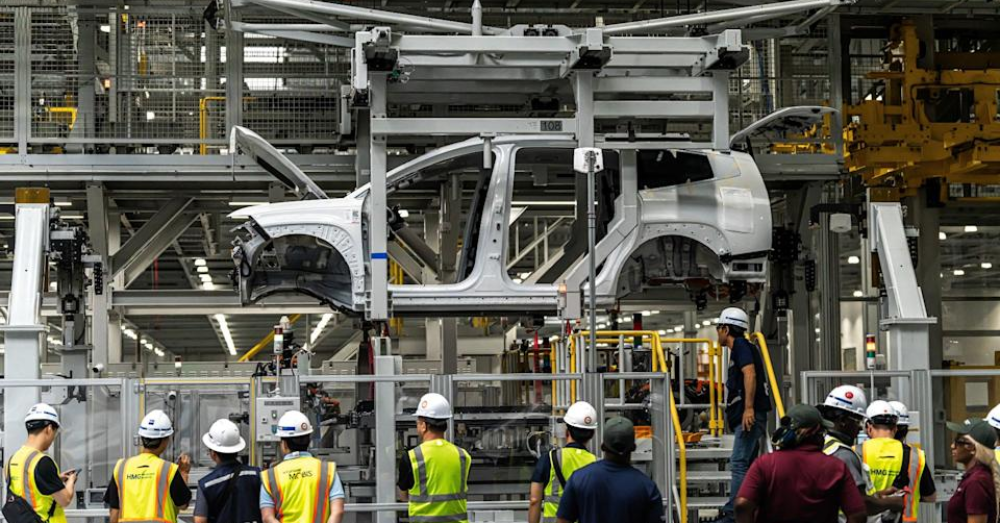
Hyundai just made one of the boldest bets in the auto industry. While most carmakers are hedging their bets on American manufacturing, the Korean automaker is going all-in with a staggering $26 billion investment plan, even as tariffs threaten to derail their ambitions. Their Georgia plant is about to become a powerhouse churning out hundreds of thousands of electric vehicles, and dealers are practically giving away IONIQ 5s for under $200 a month to get people behind the wheel.
- Hyundai is committing $26 billion to U.S. operations through 2028, with Georgia’s Metaplant America getting a $2.7 billion boost to expand production to 500,000 vehicles annually.
- The company absorbed $1.2 billion in tariff costs during Q3 2025 but successfully negotiated tariff reductions from 25% to 15% for South Korean imports.
- Dealers are offering the 2025 IONIQ 5 for as low as $189 per month with aggressive lease incentives, making it one of the cheapest EV deals in America right now.
The Georgia Gamble Gets Bigger
Hyundai’s Metaplant America in Ellabell, Georgia, opened its doors in March 2025, but the company isn’t stopping there. CEO Jose Munoz confirmed plans to expand production capacity well beyond the original 300,000-vehicle target, aiming for 500,000 units annually. This facility will build the IONIQ 5, IONIQ 9, and other electrified models for the Hyundai, Kia, and Genesis brands.
The Georgia operation represents the largest economic development project in state history and is expected to create 40,000 direct and indirect jobs. Hyundai is betting that building cars closer to customers will help it compete with Tesla and the Detroit Three while avoiding the worst effects of import tariffs.
Navigating the Tariff Storm
Hyundai absorbed brutal tariff costs in 2025, paying $1.2 billion in the third quarter alone when the Trump administration slapped 25% tariffs on vehicles from South Korea. The company successfully negotiated the rate down to 15%, saving billions, but still faces headwinds. Randy Parker, Hyundai’s North America CEO, put it bluntly: “Fifteen percent is still 15%.”
The tariff situation forced Hyundai to accelerate plans for local production. The company aims to produce 80% of its U.S. vehicles domestically by 2030, up from about 40% currently. That means the Tucson, Santa Fe, Santa Cruz, and the entire IONIQ lineup will increasingly roll off American assembly lines rather than arriving on cargo ships from Asia.
Deals Too Good to Ignore
For buyers, the timing couldn’t be better. Hyundai is fighting back against tariff costs and lost federal EV tax credits with some of the most aggressive lease deals in the industry. The 2025 IONIQ 5 starts at just $189 per month for 36 months, with a down payment of $3,999 due at signing. That works out to roughly $300 monthly when you spread out the down payment.
Dealers are sweetening the pot further. Beyond aggressive lease pricing, many locations are rolling out Hyundai service offers that bundle free scheduled maintenance and roadside assistance to keep ownership costs down. Some dealers are throwing in charging credits too, trying to offset the sting of losing that $7,500 federal tax credit that expired in September.
Compare that to Tesla’s Model Y, which leases for $299 monthly but costs about $410 when you factor in the down payment. The IONIQ 5 offers 318 miles of range in the SE trim, supports rapid charging at Tesla Superchargers via its built-in NACS port, and comes equipped with enough tech to satisfy gadget enthusiasts. Hyundai also slashed 2026 model pricing by up to $9,800 to keep momentum going.
Steel, Robotics, and the Long Game
Hyundai’s $26 billion investment goes beyond assembly plants. The company is building a Louisiana steel mill capable of producing 2.7 million metric tons annually by 2029, helping dodge the 50% tariffs on imported steel. They’re also establishing a Robotics Innovation Hub, producing 30,000 units yearly. Hyundai owns 80% of Boston Dynamics and plans to deploy that tech throughout manufacturing operations.
Should You Buy American-Made or Wait?
Hyundai’s record sales streak, five consecutive years of growth and counting, shows their strategy is working. They sold nearly 823,000 vehicles through November 2025, up 8% year-over-year. EV sales jumped 64% compared to 2024. The company is using the tariff storm as cover to remake their entire American operation.
For buyers, timing matters. Vehicles already on dealer lots avoid the extra tariff costs. Georgia-built models, such as the IONIQ 5, Santa Fe, and Santa Cruz, face smaller price increases than Korean-built vehicles. As local production scales up in 2026 and 2027, expect more competitive pricing and maintenance packages.
Hyundai is proving foreign automakers can build world-class EVs on U.S. soil while creating tens of thousands of jobs and keeping prices competitive. Whether tariffs stay at 15%, drop to zero, or climb higher, they’re building the infrastructure to weather whatever trade policy comes next.
